
Why Activewear Teams Waste 40% of Development Time and How Standardised CAD Systems Fix It
- demitracatleugh
- Nov 23, 2025
- 3 min read
Why do activewear teams spend hours redrawing the same base block… only for factories to misinterpret the design anyway?
Why do approvals stall, tech packs contradict each other, and sample rounds increase despite experienced designers and clear intentions?
If you’ve ever looked at your team’s workflow and thought, “How is everything taking this long?”, you’re not alone.
Across the GCC, growing activewear brands face one core operational truth:
Up to 40% of development time is lost to CAD inconsistency.
Not creativity.
Not innovation.
Inefficiency.
Why This Happens in Activewear Teams
Most activewear teams don’t suffer because of talent gaps they suffer because the tools and systems around the talent aren’t standardised.
Three silent issues drive the majority of wasted development hours:
1. Unstandardised CAD Systems
Each designer creates drawings based on their own habits:
One uses heavy outlines
One uses thin stroke logic
One adds panel seams
One doesn’t
One uses US letter sizing
One designs on A4 with no grid system
On their own, none of these choices are wrong.
But together, they create completely incompatible drawing languages.
So factories, merch teams, and junior designers all interpret these drawings differently.
2. Misaligned File Logic
Grow a team from one designer to three and suddenly:
CAD libraries don’t match
base blocks don’t align
the same legging exists in five versions
nobody knows which version is “final”
This leads to re-drawing, re-formatting, re-explaining, and constant re-checking.
3. Inefficient Onboarding
Without systemised CAD standards:
hiring becomes slow
juniors take months to onboard
senior designers become “bottlenecks” because only they understand the correct logic
As teams scale (especially across UAE, KSA, and Qatar), inconsistency compounds.
The result? Designers spend more time aligning files than designing product.
The Cost of the Problem
CAD inconsistency doesn’t just look messy, it has measurable financial impact.
Here’s the true cost:
20–40% of development time is lost to re-drawing, re-formatting, and clarifications
Sampling rounds increase by 1–3 cycles, adding thousands in unnecessary cost
Approvals slow down, delaying drops and reducing agility
Fit inconsistency emerges, damaging brand trust
Factories lose clarity, leading to misinterpretation and communication loops
For GCC brands working with fast retail cycles and higher expectations from premium customers, this isn’t just inefficient
it directly erodes margin and slows growth.
How the Modular Precision CAD System™ Fixes This
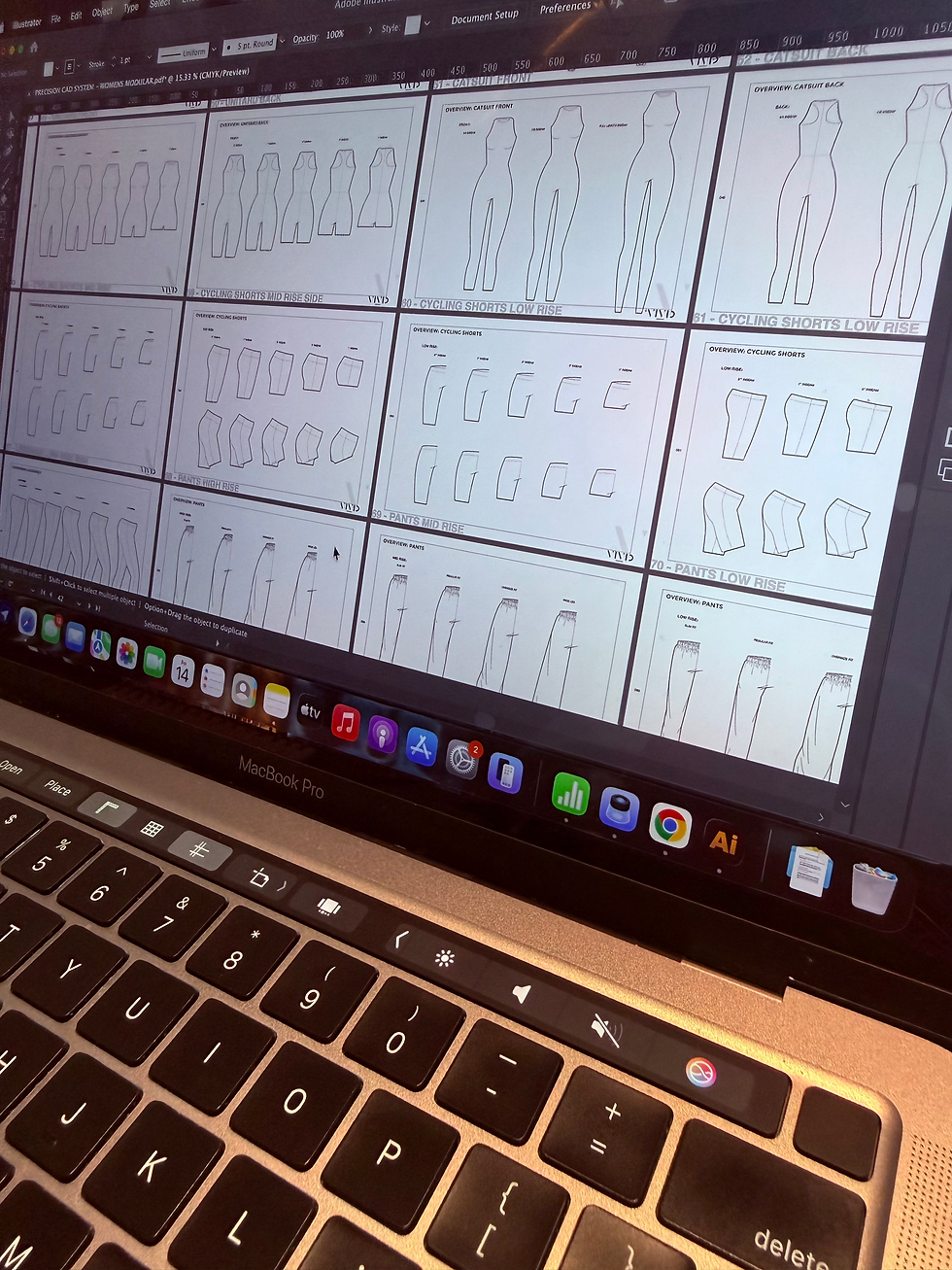
The Modular Precision CAD System™ was engineered specifically for fashion and activewear brands scaling from 5 to 50 designers across the GCC.
It eliminates design inconsistency at the source by introducing one unified drawing language for your entire team.
1. Standardised Design Logic
Every line weight, seam, construction detail, and layout is already systemised:
Consistent stroke hierarchy
Precise annotation logic
Pre-structured page layouts
Drawing language aligned with factory interpretation
Your designers stop debating drawing style and start designing product.
2. Modular Fit Blocks
Instead of every designer redrawing the same base shapes, the system includes:
master legging blocks
performance tops
sports bras
jackets
shorts
adjustable modular overlays
All blocks interlock with identical logic meaning fast changes, fewer errors, and clear fit consistency across collections.
3. Rapid Onboarding
Junior designers, freelancers, and new hires can produce CAD-ready drawings from day one.
No more months of alignment.
No more correcting drawing logic.
No more “This isn’t how we draw seams here.”
4. Factory-Ready Output
The system speaks the language your factory actually needs:
Clear seam construction
Correct grainline logic
Consistent call-outs
Optimal line precision for sampling
That means faster approvals, fewer clarifications, and reduced sample rounds.

Proof & Authority: Why Leading GCC Brands Systemise Now
Across the UAE, Saudi Arabia, and Qatar, brands scaling in 2025 are moving away from talent-led workflows and toward system-led precision.
Why?
Because scaling teams, launching more drops, or working with multiple factories requires uniformity not improvisation.
Brands that implement CAD standardisation early see:
Faster approvals
Reduced sampling cost
Improved cross-team alignment
Fewer production errors
Higher-quality design output

The Fastest-Growing Brands in 2025 Are Systemised Ones
The activewear brands growing fastest in the GCC share one thing in common:
They’ve standardised their design language.
If you’re scaling your team…
If your approvals are slowing down…
If your factory keeps misinterpreting your drawings…
If your designers are redrawing the same CADs every week…
Then it’s time to implement the system built for growth.
Discover the Modular Precision CAD System™: the activewear industry’s design language standard.
For bespoke guidance:


Comments