
Why Intent Misalignment Slows Activewear Product Development
- demitracatleugh
- Mar 18
- 5 min read
Intent misalignment is one of the most persistent and least visible sources of delay in activewear product development. It occurs when the structural and functional purpose of a garment is not fully understood the same way by design, product development, and manufacturing teams. The garment exists visually, but its intended role, construction logic, and performance priorities remain open to interpretation.
This problem rarely appears as an obvious error. CAD drawings may be clean, proportions balanced, and specifications complete. However, when teams begin evaluating the garment during development or sampling, questions emerge about structural intent rather than execution quality. Seam placement may appear correct visually but lack clarity about its functional purpose. Panel construction may look balanced but not clearly communicate load distribution or compression intent. Fit direction may be aesthetically defined but not structurally anchored.
In activewear design workflows, where garments rely heavily on engineered construction rather than decorative assembly, these gaps have operational consequences. Development teams cannot execute efficiently without clear structural intent. Sampling cycles extend while teams reconstruct the original purpose of design decisions. Progress slows not because of execution difficulty, but because intent was never fully stabilised before development began.
Intent misalignment affects timeline predictability, revision frequency, and design team efficiency. Understanding how it emerges and how it compounds allows teams to identify structural gaps early, before they disrupt the broader fashion product development process.
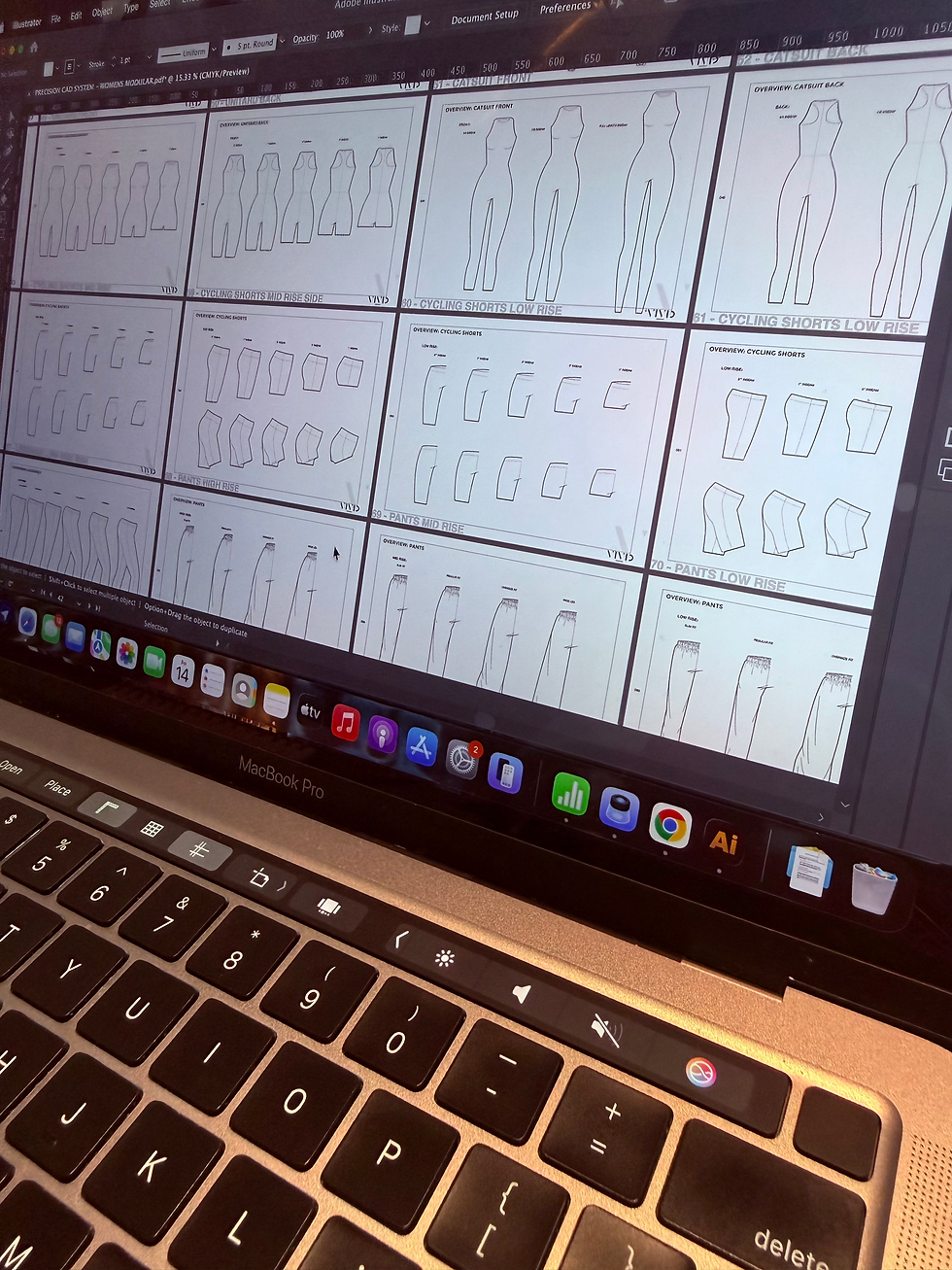
Why intent misalignment happens in activewear design teams
Intent misalignment is not caused by poor design decisions. It emerges from structural gaps in how design intent is defined, documented, and transferred across the activewear design workflow.
Structural decisions are implied rather than explicitly defined
Design intent is often communicated visually rather than structurally. CAD files may show seam placement and panel relationships clearly, but the functional reasoning behind those decisions remains implicit. Without explicit structural definition, development teams must interpret purpose based on visual cues alone.
This interpretation process introduces variability.
Structured approaches to CAD consistency and structural definition are explored in foundational workflow resources such as the activewear design workflow overview.
Visual clarity is mistaken for structural clarity
Garments that appear visually resolved may still contain unresolved structural decisions. Seam placement may be visually balanced but not optimised for stretch direction, load distribution, or manufacturing stability.
Visual resolution does not guarantee structural resolution.
Design and development evaluate garments through different operational priorities
Design teams prioritise proportion, silhouette, and aesthetic balance. Development teams prioritise reproducibility, pattern stability, and manufacturing feasibility. Without explicit structural alignment, both teams may evaluate the same garment differently.
This divergence creates hesitation rather than immediate progression.
Workflow speed prioritises progression over structural validation
Fast-moving design cycles often prioritise forward movement. Structural assumptions remain untested until development or sampling phases. When these assumptions surface later, development pauses while intent is clarified.
This shifts structural resolution downstream, where changes have greater operational impact.
How intent misalignment shows up day-to-day
Intent misalignment rarely appears as obvious failure. It presents as subtle friction within daily activewear design workflow operations.
Design reviews pause unexpectedly
During development reviews, teams pause to confirm whether structural elements were intentional or incidental. Seam positioning, panel segmentation, or fit shaping may appear deliberate but lack explicit confirmation.
These pauses indicate incomplete structural transfer.
CAD handover triggers clarification questions
Development teams reviewing CAD files often ask questions about panel hierarchy, seam relationships, or proportional intent. These questions reflect structural ambiguity rather than execution difficulty.
This pattern is closely related to broader discussions around CAD consistency in fashion product development.

Sampling feedback focuses on confirming intent
Instead of validating performance characteristics such as stretch recovery or durability, sampling feedback focuses on confirming structural purpose. Teams revisit earlier decisions to understand intended outcomes.
Sampling shifts from validation to interpretation.
Alignment pauses progression between teams
Product development teams hesitate to advance garments when structural intent remains unclear. Progress slows while alignment is re-established across design and technical teams.
This hesitation protects manufacturing stability but delays development timelines.
Why the impact compounds over time
Intent misalignment creates cumulative operational drag rather than immediate visible disruption.
Timelines extend incrementally
Each clarification introduces small delays. While individually minor, these delays accumulate across garments and collections. Development schedules gradually shift beyond initial projections.
This shift reduces predictability.
Revisions focus on reconstructing intent rather than refining performance
Sampling revisions may address structural purpose rather than performance improvement. Seam placement, panel logic, or proportional relationships may change even when execution quality is high.
This increases revision cycles without improving garment performance.
Cross-team confidence decreases
Teams become less certain about whether garments accurately represent final intent.
Approval decisions slow as teams seek confirmation before progressing.
Alignment requires additional verification.
Workflow momentum separates across collections
Some garments progress smoothly while others remain in clarification cycles. This inconsistency affects collection cohesion and production planning.

Common questions teams ask about intent misalignment
Why does intent misalignment slow production?
Production requires precise structural definition. When intent remains open to interpretation, production teams cannot confidently prepare patterns, grading, or manufacturing sequences.
Clarification must occur before production can proceed.
How can teams identify intent misalignment early?
Intent misalignment can be identified when development discussions focus on structural interpretation rather than performance refinement. Repeated questions about seam purpose, panel function, or proportional logic indicate incomplete structural transfer.
Teams exploring structural clarity principles sometimes examine foundational reference systems, including baseline exploration tools such as the Precision CAD mini pack, to understand how consistent structural logic improves alignment.
Is intent misalignment caused by individual designers?
Intent misalignment reflects workflow structure rather than individual skill. Designers operate within existing systems. When structural frameworks are inconsistent, intent must be reconstructed repeatedly.
System stability determines alignment efficiency.
Why does intent misalignment affect activewear more than other categories?
Activewear construction relies heavily on engineered structural relationships. Compression zones, stretch direction, and ergonomic shaping depend on precise structural logic. Small ambiguities have amplified effects.
Structural clarity is therefore more critical.
Further structural workflow analysis is available in related discussions on sampling stability in activewear development.
How experienced teams mitigate intent misalignment
Experienced teams reduce intent misalignment by stabilising structural clarity before development begins.
Structural frameworks define construction logic early
Rather than defining structural relationships from scratch each cycle, teams operate within consistent structural frameworks. Seam logic, panel balance, and proportional relationships are stabilised before design execution.
This reduces interpretation variability.
CAD consistency supports predictable execution
Consistent CAD construction logic ensures development teams receive familiar, stable references. Structural relationships remain predictable across garments.
This improves development efficiency.
Structural intent is explicitly documented
Intent is clearly embedded within CAD and technical documentation. Development teams can execute garments confidently without reconstructing purpose.
Alignment is established earlier.
Sampling validates performance rather than clarifies intent
When structural clarity exists early, sampling focuses on performance validation rather than structural correction. Development progresses more predictably.
Intent misalignment slows activewear product development not through visible errors, but through structural ambiguity. When garment purpose, construction logic, and proportional intent remain implicit, development teams must reconstruct foundational decisions during later phases.
This reconstruction extends timelines, increases revisions, and reduces workflow predictability. Sampling becomes a phase of clarification rather than validation.
Experienced teams mitigate intent misalignment by stabilising structural clarity before development begins. Consistent CAD logic, explicit structural documentation, and shared intent frameworks enable teams to progress efficiently.
In activewear design workflows, development speed reflects clarity of intent more than execution speed. When intent is fully stabilised early, development becomes more predictable, sampling becomes more efficient, and collections progress with greater structural confidence.


Comments