
Why Sampling Delays Quietly Compound in Activewear Product Development
- demitracatleugh
- Mar 4
- 6 min read
Sampling delays are often attributed to factory timelines, material availability, or capacity constraints. However, in activewear design workflows, many sampling delays originate earlier, during the translation of design intent into executable structure. The delay is not caused by the sample itself. It emerges when unresolved structural decisions surface during sampling, forcing teams to pause progression and revisit foundational assumptions.
In practical terms, sampling delays occur when garments reach physical evaluation before their construction logic has been fully stabilised. Seam placement may be visually approved but not structurally defined. Panel proportions may align aesthetically but lack clear dimensional intent. Fit targets may exist conceptually but remain undefined in technical documentation. When these gaps surface during sample review, development shifts from refinement to reconstruction.
This distinction has operational consequences. Sampling is intended to validate performance, proportion, and reproducibility. When sampling becomes a phase of structural clarification, timelines extend beyond planned cycles. Teams pause forward momentum to re-evaluate decisions that should have been resolved earlier in the fashion product development process. The result is not a single visible delay, but a gradual loss of alignment, predictability, and design team efficiency.
In activewear, where garments rely heavily on engineered seam placement, compression zoning, and performance-driven pattern logic, structural clarity is particularly critical. Minor ambiguities in early CAD stages can propagate into multiple downstream revisions. Understanding how and why sampling delays compound allows teams to identify the issue before it disrupts development flow.

Why sampling delays happen in activewear design teams
Sampling delays rarely originate from individual performance or decision-making speed. They emerge from gaps in structural definition during earlier phases of the activewear design workflow.
Several systemic conditions contribute to this pattern.
Structural intent is not fully codified in CAD
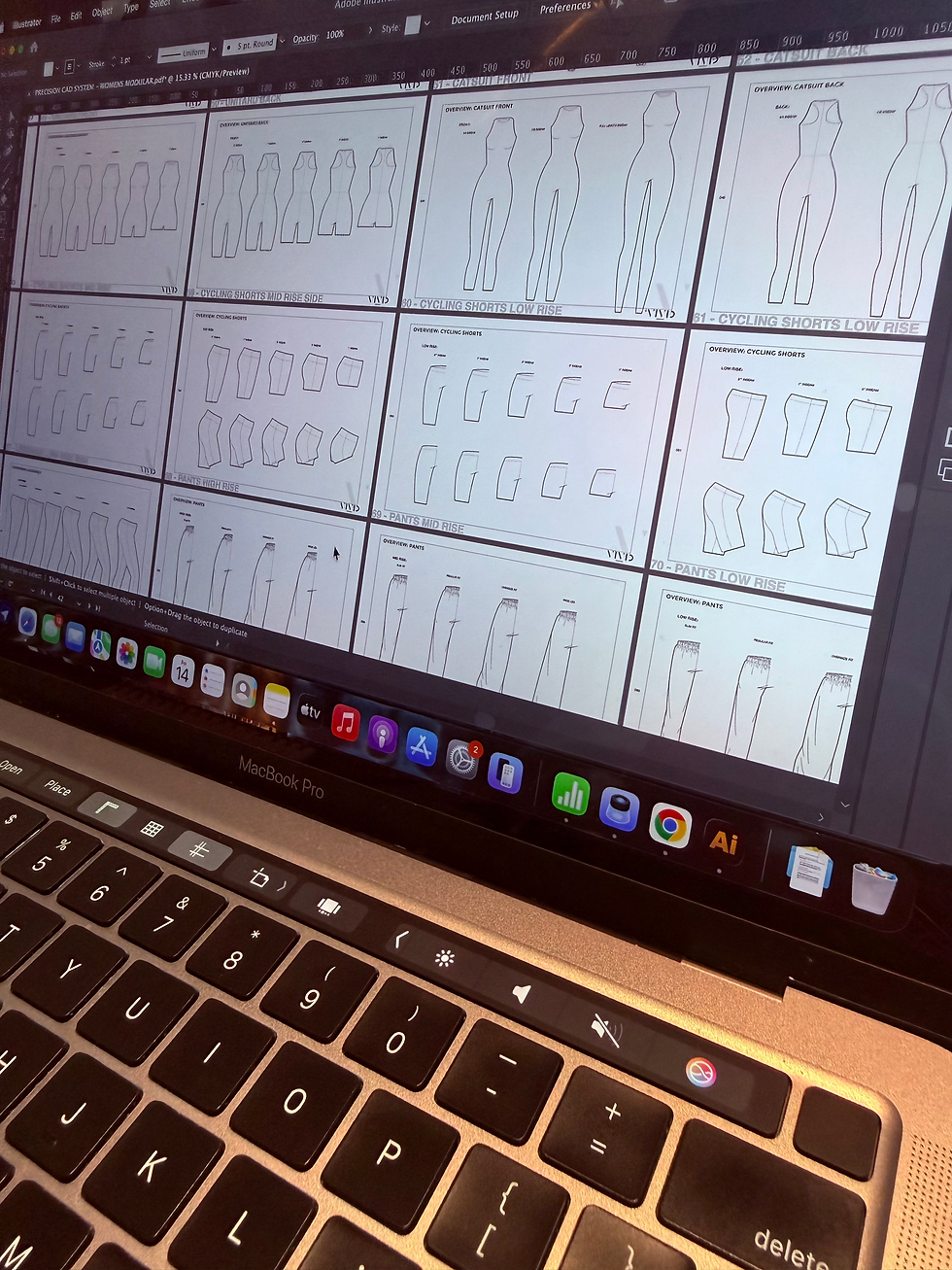
CAD drawings often prioritise silhouette communication rather than construction precision. Visual alignment may appear correct, but seam intersections, panel balance, and proportional relationships may lack technical specificity. Without explicit structural intent embedded in CAD, interpretation shifts downstream to development and sampling teams.
This pattern is particularly common when teams rely on individually constructed CAD files rather than shared structural baselines. Without consistent starting frameworks, each garment effectively begins as a unique construction exercise.
Contextual expertise on structural baselines and workflow clarity can be explored in structured CAD frameworks such as the foundational systems outlined in the Precision CAD workflow overview.
Design and development evaluate garments through different lenses
Design teams evaluate garments based on aesthetic execution, proportion, and visual balance. Development teams evaluate garments based on reproducibility, pattern stability, and manufacturing logic. When structural intent is not explicitly transferred between teams, each group interprets the garment differently.
This divergence does not indicate disagreement. It reflects incomplete transmission of intent.
Activewear construction complexity increases structural sensitivity
Activewear garments rely heavily on precision. Compression panels, ergonomic seam lines, and performance fabrics interact in ways that amplify structural ambiguity. Minor proportional shifts in CAD can materially affect fit recovery, seam stress distribution, and panel stability.
Because of this sensitivity, structural clarity must be established earlier than in less performance-dependent categories.
Workflow speed masks structural uncertainty
Fast-moving design cycles can give the appearance of efficiency while structural decisions remain unresolved. The garment progresses visually, but foundational construction logic remains implicit rather than explicit. Sampling then becomes the phase where implicit assumptions are tested and often corrected.
How this problem shows up day-to-day
Sampling delays rarely present as obvious errors. Instead, they appear as small pauses, clarification questions, and repeated structural confirmations across the activewear design workflow.
Design reviews focus on confirming intent rather than refining performance
During sample review, teams revisit seam placement, panel orientation, or proportional relationships that were assumed to be resolved. Instead of assessing stretch recovery, fabric behaviour, or ergonomic performance, discussions shift toward reconstructing original design intent.
This signals that structural clarity was incomplete during earlier design phases.
CAD handover triggers interpretation rather than execution
Development teams receiving CAD files often ask clarification questions about construction logic, panel relationships, or seam hierarchy. These questions do not reflect errors in execution but gaps in structural definition.
This pattern is explored in more detail in related workflow analyses covering CAD consistency in activewear design.

Sampling feedback focuses on correcting structure rather than validating performance
Sample revisions frequently involve structural adjustments such as repositioning seam lines, rebalancing panels, or redefining compression zones. These changes indicate that structural intent was stabilised during sampling rather than before it.
This extends sampling cycles beyond their intended purpose.
Cross-team alignment pauses progression
Product development teams may hesitate to approve samples when structural intent appears ambiguous. This hesitation reflects uncertainty about whether the garment represents final intent or an intermediate interpretation.
Progression pauses until alignment is re-established.
Why the impact compounds over time
Sampling delays rarely occur in isolation. Their impact compounds across timelines, alignment, and operational efficiency.
Timelines shift incrementally rather than dramatically
Each clarification or revision may extend timelines only slightly. However, across multiple garments and collections, these extensions accumulate. Development calendars begin to drift relative to initial schedules.
This drift often appears gradual rather than abrupt, making it harder to attribute to a single cause.
Rework increases structural instability
Repeated structural revisions introduce new variables. Adjustments made during sampling can affect panel balance, fit stability, and proportional relationships. Subsequent revisions must then reconcile these new variables.
This cycle increases structural volatility across the product line.
Sampling rounds increase without visible design changes
Multiple sampling rounds may occur even when visual design remains stable. These rounds focus on stabilising construction logic rather than refining aesthetic or performance outcomes.
This pattern reduces predictability within the fashion product development timeline.
Internal alignment weakens across teams
When structural clarity is inconsistent, different teams develop different interpretations of the same garment. This divergence affects decision speed, approval confidence, and workflow cohesion.

Common questions teams ask about sampling delays
Why do sampling delays slow production?
Sampling delays slow production because production requires stable structural references. When structural intent shifts during sampling, production preparation must pause until construction logic stabilises.
Factories rely on clear, consistent specifications to prepare patterns, grading, and material allocation.
How can teams identify sampling delays early?
Sampling delays can be identified early when sample reviews focus disproportionately on structural clarification rather than performance validation. Frequent structural revision requests signal that foundational intent was not fully resolved before sampling.
Another early indicator is repeated clarification requests during CAD handover.
Teams exploring structural consistency principles sometimes use structured CAD reference frameworks, including foundational exploration tools such as the Precision CAD mini pack, to understand how baseline stability influences downstream clarity.
Is this a skill issue or a system issue?
Sampling delays are primarily a system issue. Individual designers operate within the constraints of existing workflows. Without structured baselines and consistent structural references, each garment requires reconstruction of foundational decisions.
System clarity determines workflow stability.
Why does this affect junior designers more?
Junior designers typically operate without extensive internal structural references. They may rely more heavily on interpretation rather than predefined structural logic. Without consistent frameworks, their development timelines appear slower even when their execution quality is high.
This pattern reflects workflow structure rather than individual capability.
Further discussion on structural workflow clarity and development stability is available in analyses covering activewear product development systemisation.
How experienced teams mitigate this problem
Experienced teams mitigate sampling delays by prioritising structural clarity earlier in the activewear design workflow. Their approach focuses on consistency, alignment, and system stability rather than speed alone.
Structural baselines are established before design execution
Rather than constructing each garment from scratch, teams operate within predefined structural frameworks. These baselines define seam logic, proportional relationships, and panel hierarchy.
Design execution then builds upon stable structural foundations.
CAD consistency is maintained across collections
Consistent CAD construction logic reduces interpretation variability. Development teams can execute garments with greater predictability because structural relationships remain familiar and stable.
This improves design team efficiency and reduces sampling variability.
Intent is explicitly transferred between teams
Structural intent is clearly defined within CAD documentation and tech packs. This ensures that design and development evaluate garments using shared reference points.
Alignment is established before sampling begins.
Sampling is used for validation rather than reconstruction
When structural clarity is established early, sampling validates fit, performance, and material behaviour rather than redefining construction logic.
This stabilises timelines and improves workflow predictability.
Sampling delays in activewear product development rarely originate from the sampling phase itself. They emerge when structural intent remains implicit rather than explicitly defined during earlier design stages. Sampling then becomes a phase of reconstruction rather than validation.
This shift affects timelines, alignment, and workflow stability across the entire product development cycle. Small structural ambiguities propagate into repeated revisions, extended sampling rounds, and reduced predictability.
Experienced teams address this issue by establishing structural clarity before garments reach sampling. Consistent CAD logic, shared structural references, and explicit intent transfer enable sampling to function as intended: validating performance rather than redefining construction.
In activewear design workflows, progression speed reflects structural clarity more than execution pace. When foundational intent is stabilised early, development timelines become more predictable, alignment improves, and sampling supports forward momentum rather than delaying it.


Comments